Bravo, España
Why Pedro Sánchez Deserves a Salute

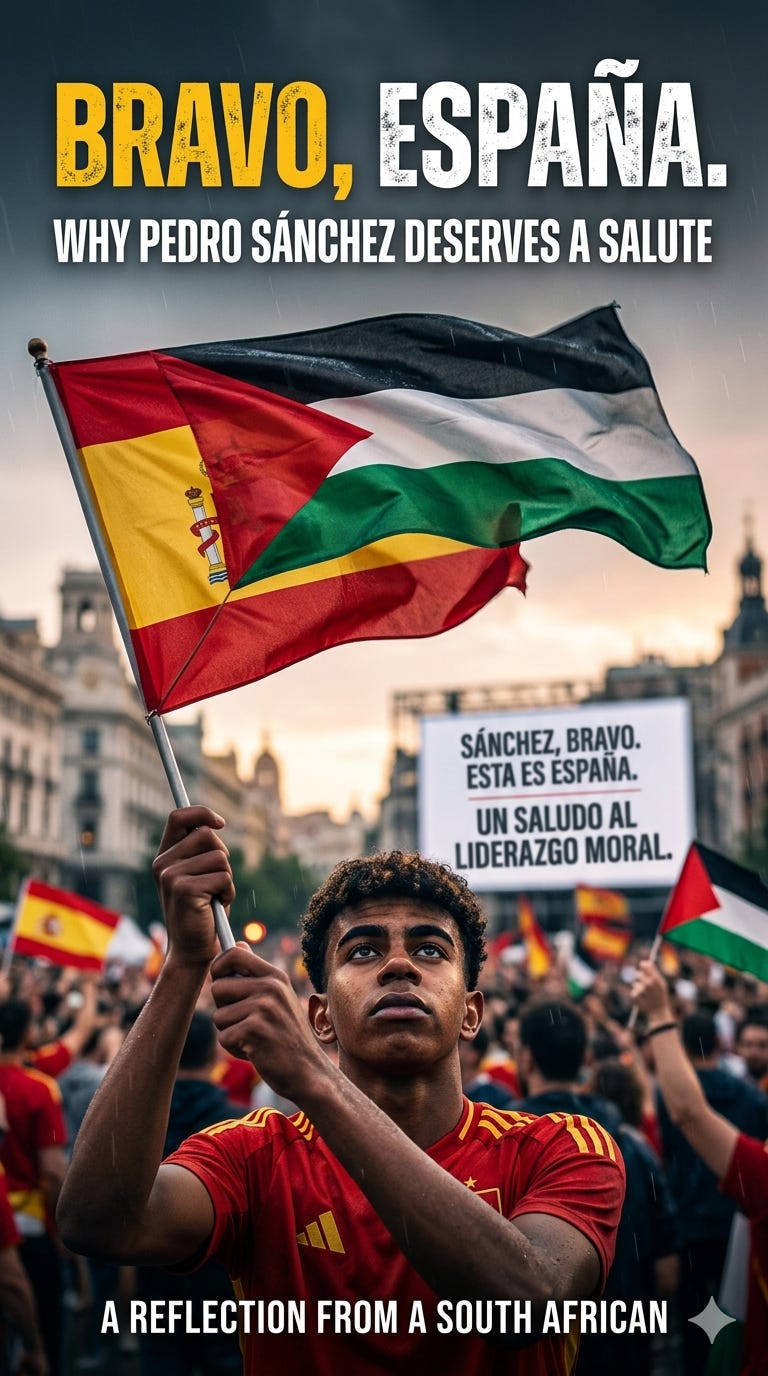
When an 18-year-old footballer waves a flag during a victory parade, and an Israeli defence minister calls it an act of incitement, the revealing question is not about the teenager. The revealing question is who chooses to stand up and say: enough.
Pedro Sánchez did. Spain's Prime Minister did not hedge. He did not defer. He did not issue the usual bland call for 'both sides to exercise restraint'.
Instead he said plainly that anyone who considers waving the flag of a recognised state to be incitement has 'either lost their judgment or been blinded by their own ignominy'.
He said Lamine Yamal had expressed the solidarity with Palestine felt by millions of Spaniards, and that it gave him yet another reason to be proud.
Bravo, España.
As a South African, I have watched the last two years with a particular kind of anguish. It is not only the horror unfolding in Gaza that breaks my heart, though that alone would be enough. It is the near-total moral failure of Western democratic leadership.
The countries that lecture the world about a rules-based order have instead provided cover, weapons and diplomatic protection to a military campaign that has killed tens of thousands of civilians, levelled hospitals and left no credible plan for the day after.
The West Bank bleeds under accelerating settler violence. Buffer zones have been carved into Lebanese and Syrian territory. The silence from Washington, London and Brussels remains, with rare exceptions, deafening.
Yet one Western leader has consistently risen to speak truth to power. Sánchez has imposed a total, legally binding arms embargo on Israel, the first European country to do so.
He has explicitly labelled the situation in Gaza a 'genocide', accusing Netanyahu's government of 'exterminating a defenceless people' by bombing hospitals and killing children with hunger.
These are not the words of a revolutionary or an ideologue. Sánchez leads a coalition government in a NATO member state. He navigates real constraints. What distinguishes him is simpler: he is neither financially compromised nor politically captive. The moral arithmetic is not complicated, and he has chosen not to pretend otherwise.
His courage extends beyond Gaza. When the United States government imposed sanctions on the UN Special Rapporteur Francesca Albanese for simply doing her job and presenting the facts, Spain stood tall. Despite a horrific international campaign to vilify and silence her, Sánchez awarded her the Order of Civil Merit, calling her 'a voice that upholds the conscience of the world'. In a world where power silences truth, Spain has given her a platform.
The other voices of conscience on this conflict have largely come from the Global South: Brazil's Lula, South Africa's Ramaphosa, the African Union. Their moral standing is real. But there is a particular significance when a Western European head of government breaks ranks. It exposes the silence of the others for what it is: a choice. Not a necessity, not a geopolitical constraint, but a deliberate decision to look away.
South Africa has paid a price for its own principled stand at the International Court of Justice. We know what it costs to speak truth to power. We have faced threats, diplomatic pressure and accusations of bias. Pedro Sánchez knows that cost too. He has faced similar attacks. Yet he has not flinched. By joining South Africa's genocide case against Israel at the ICJ, he has shown genuine solidarity with our nation's pursuit of justice.
That is why his voice matters. That is why it deserves to be heard far beyond Spain's borders. In a world desperately short of leaders with integrity, Pedro Sánchez is showing us what it means to lead. The rest of the West should be ashamed, but more importantly they should be taking notes.
Bravo, España. Nkosi.